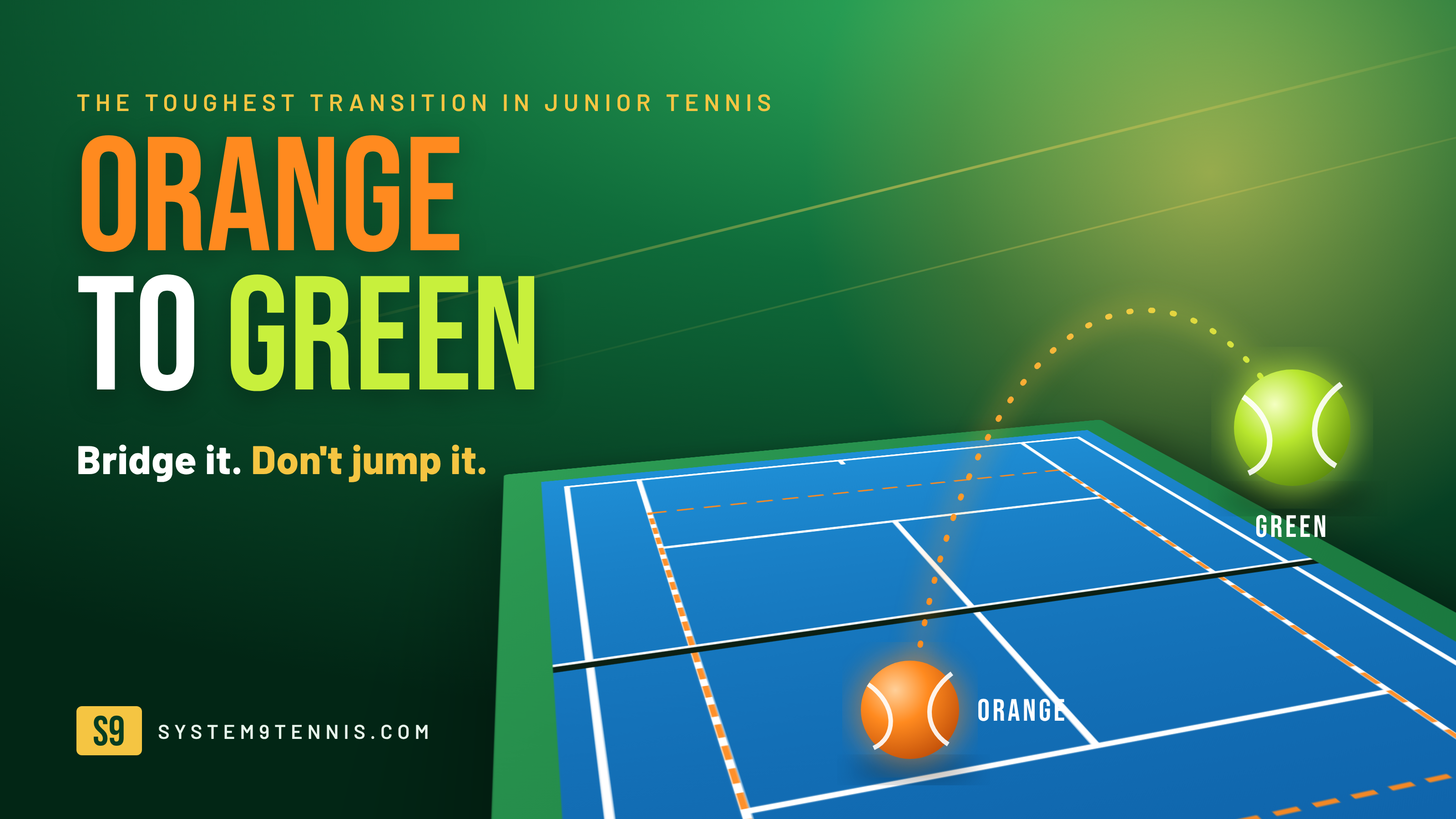
Orange to Green: Bridging the Toughest Transition
Orange to Green: Bridging the Toughest Transition in Junior Tennis
Oct 21, 2026 · @system9tennis
The transition coaches dread
Ask any coach which step on the junior pathway keeps them up at night, and most will say the same thing: orange to green ball. Or at least that’s what everyone is saying in my social posts!
Red to orange feels like a celebration where players cannot wait to move up a colour. Green to yellow feels like graduation. But orange to green? That's where for most rallies perhaps collapse, confidence may drops, parents start asking questions, and good young players maybe quietly stop enjoying the game.
A player who looked brilliant on the orange court suddenly can't keep three balls in on the full court which leads to the coach panicking and the child decides they're "not good at tennis anymore".
The good news however is it doesn't have to be that way. The problem isn't the player I believe it is how we move them.
Why players stall at green
On paper it's just a slightly faster ball but in reality, everything changes at once:
- The court grows. Players go from the orange court to the full 23.77m court. Suddenly there's far more ground to cover and far more space to miss into.
- The ball speeds up and bounces higher. Contact points that worked on orange now arrive at shoulder height. Swings that were "just right" now fly long.
- The serve gets exposed. A full-length service box and a full-height net punish any serve that relied on the shorter court.
- The tactics change. On orange, consistency helps wins. On green, players need the start of real patterns of play and almost nobody teaches them that explicitly.
- The head gets involved. Losing more points than before hits confidence.
Most coaches try to fix all five at once, in the same week, with the same drills and I believe that's the mistake.
The SYSTEM-9 way: bridge it, don't jump it
In SYSTEM-9 we don't treat orange to green as a single jump. We treat it as a bridge to a planned, staged journey built into a 10-year development pathway.
Three principles sit underneath it:
- One change at a time. Change the ball before you change the court, or the court before you change the ball never everything on day one. Players need a win before they face the next challenge.
- Stages, not ages. A player moves when they've shown the skills of the stage, not because they've had a birthday. The 9-stage structure gives coaches clear markers so nobody guesses.
- Same session, new challenge. The SYSTEM-9 lesson framework from Free Play through to Wrap-Up stays exactly the same. Familiar structure means the player only has to adapt to the tennis, not to a whole new way of training.
When the structure stays steady, the child copes with the change. When everything shifts at once, they don't.
Five things you can do this week
- Run a "bridge" block. Introduce the green ball on the orange court first. Let players feel the extra bounce and speed on a court they already own before you open up the full length.
- Teach height and depth, not power. The single biggest fix at green is getting players to hit higher over the net with more spin. Set safe targets in the court and reward depth over pace.
- Rebuild the serve and return early. Give serving and returning their own slot in every session. On the full court, the point starts and is often lost here. If we are going to start with a drop feed why not start with a baby serve in the service boxes or a serve action that does not need to land in to start a long line rally.
- Give them their first tactics. Both players back, the approach, the passing shot. Simple patterns give players a reason to hit the ball somewhere, which lifts their consistency faster than any feeding drill.
- Change the scoring, protect the confidence. Use scoring games that reward the new skill so players can "win" while they're still learning to win matches. I use situations such as the player who serves is the winner, the player standing in the deuces side is the winner when I call stop.
Do these in order and you'll see rallies return within weeks, not months.
Where the books come in
Everything above is written out, stage by stage, in the SYSTEM-9 library. You don't have to invent the bridge yourself it's already built.
SYSTEM-9 Orange Ball (ages 8–9)
Shows exactly what a player should own before they move up, so you know when they're ready — not just old enough.
SYSTEM-9 Green Ball (10+)
The heart of the transition: serving and returning, both back, the approach, passing shots and match-play psychology, laid out in stages.
Singles Tactics
Gives green ball players their first real patterns, so every shot has a purpose.
Scoring Systems and Games for Tennis
A 4-stage scoring progression and teaching games that keep confidence up while the level goes up.
Lesson Planning in a Nutshell and the Group Planning Booklet
Ready-made session structures so you can run a full green ball programme without starting from a blank page.
14 Tennis Psychology Fundamentals
Helps players handle the first real dip in results — the moment most children give up.
SYSTEM-9: The Complete Journey
Seven books in one 10-year programme, so you can see where orange and green sit in the whole pathway.
Coaches using SYSTEM-9 tell me the same thing: they stop guessing. They know what to teach, in what order, and what "ready" looks like. That confidence passes straight to the players and to the parents watching from the fence.
And a programme where players progress smoothly is a programme with a waiting list.
Stop losing players at green
Orange to green will always be a big step. But it should be a step players climb, not a cliff they fall off.
Get the Orange Ball and Green Ball books together and build your bridge this season. Pick them up at system9tennis.com or on Amazon.
Your players are ready for green. Make sure your programme is too.
— Andy Dowsett, Founder, SYSTEM-9 Tennis